

If you’ve started finding more hair than usual on your pillow, in the shower drain, or mysteriously attached to your black T-shirt, it’s understandable to start investigating every possible culprit.
And if you vape, one question may quickly pop into your head: does vaping cause hair loss?
The honest answer is: there isn’t enough direct human evidence to say that vaping causes hair loss. However, that doesn’t mean the question is completely baseless. Nicotine can affect blood vessels, and research on cigarette smoking has found an association with some forms of hair loss. Since many vapes deliver nicotine, researchers have a reasonable biological pathway to investigate—but we shouldn't turn a plausible mechanism into a proven fact.
For this one, I also went down the rabbit hole of dermatology research, because blaming every lost hair on your vape would be about as scientifically sound as blaming your receding hairline on Monday mornings.
Here’s what we actually know.
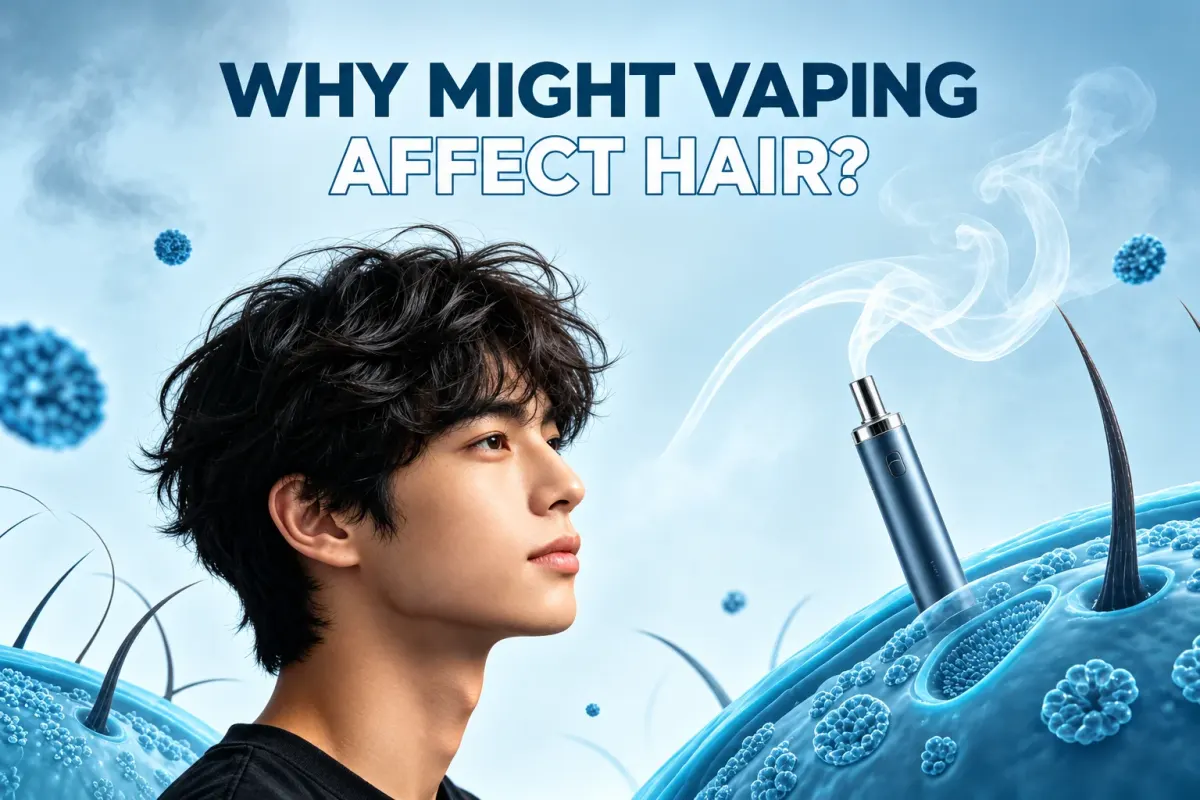
Why might vaping affect hair?
This is where things get interesting.
1. Nicotine can constrict blood vessels
Most nicotine-containing vapes deliver nicotine into the bloodstream. Research has demonstrated that nicotine can affect blood flow in the skin and subcutaneous tissue. In one human study, nicotine infusion reduced subcutaneous blood flow, while cigarette smoking produced reductions in blood flow and tissue oxygenation.
Hair follicles are living structures. They depend on blood vessels to supply oxygen and nutrients.
The theory is therefore fairly straightforward:
Nicotine → vasoconstriction → altered blood flow → potentially less favorable conditions for hair follicles.
That sounds convincing on paper, but there is an important scientific speed bump: a plausible mechanism is not the same thing as proof that vaping causes baldness.
The systematic review on smoking and androgenetic alopecia specifically noted that although vasoconstriction is one proposed mechanism, large controlled studies proving causation are still missing.
2. Nicotine isn't the only thing researchers are interested in
Vape aerosol isn't simply "water vapor."
Depending on the device, e-liquid and operating conditions, aerosol can contain nicotine, flavoring chemicals and other compounds. Researchers are still studying the long-term effects of these exposures.
One study using data from the U.S. Population Assessment of Tobacco and Health study found that exclusive users of nicotine-containing e-cigarettes had substantially higher nicotine-metabolite concentrations than non-tobacco users. In other words, vaping nicotine isn't just theoretical exposure—your body actually absorbs it.
However, that study investigated nicotine exposure, not hair loss.
That's another distinction worth keeping in mind.
3. Oxidative stress may be part of the conversation
Oxidative stress is another proposed pathway.
The smoking-and-hair-loss literature has suggested that oxidative stress may damage cells around the hair follicle and contribute to changes in the hair-growth cycle. The 2022 systematic review identified oxidative stress, DNA damage and inflammation among possible mechanisms connecting smoking with androgenetic alopecia.
There is also experimental evidence from animal research.
For example, one study exposed mice to cigarette smoke for three months and observed areas of alopecia, changes in hair follicles and damage around the hair bulbs.
But before anyone starts comparing their scalp with a laboratory mouse, there's an obvious limitation:
Animal cigarette-smoke research isn't proof that vaping causes human hair loss.
It tells researchers something about possible biological mechanisms. It doesn't settle the question.
What type of hair loss are we talking about?
This is something I think gets overlooked in online discussions.
"Hair loss" isn't one single condition.
According to the American Academy of Dermatology (AAD), people can experience excessive hair shedding, hereditary hair loss, alopecia areata and several other forms of hair loss.
1. Pattern hair loss
Androgenetic alopecia is the classic gradual thinning associated with genetic and hormonal factors.
For men, it often appears as:
- A receding hairline
- Thinning around the crown
- A gradually expanding bald area
For women, it more commonly appears as diffuse thinning, particularly around the part line.
Smoking research has found associations between smoking and androgenetic alopecia, but again, that doesn't prove vaping causes the same condition.
2. Telogen effluvium
This one is different.
You might suddenly notice considerably more hair coming out when showering or brushing.
The AAD notes that normal daily shedding is around 50–100 hairs per day, while excessive shedding can occur after significant physical or emotional stress, illness, high fever, surgery, substantial weight loss and other triggers.
And here's the frustrating part: telogen effluvium can appear months after the original trigger.
So if you started vaping six months ago and started losing hair this week, don't automatically assume you've caught your vape red-handed.
There may be something else going on.
What are the more common causes of hair loss?
If you're experiencing noticeable thinning, vaping shouldn't automatically become suspect number one.
Depending on the type of hair loss, possibilities include:
- Genetics
- Hormonal changes
- Androgenetic alopecia
- Alopecia areata
- Major stress
- Illness or high fever
- Significant weight loss
- Nutritional deficiencies
- Certain medications
- Thyroid problems
- Tight hairstyles or repeated hair traction
- Harsh hair treatments
The AAD notes that excessive shedding can follow events such as significant weight loss, childbirth, severe stress, fever and illness, while hereditary hair loss can cause progressive thinning.
Alopecia areata is another possibility. It's an autoimmune condition in which the immune system attacks hair follicles, potentially causing round or patchy hair loss.
Interestingly, the AAD also reports that long-term cigarette smoking has been associated with a higher risk of alopecia areata. But, once again, that's evidence about cigarettes, not a direct finding that vaping causes alopecia areata.
Can quitting vaping reverse hair loss?
This is another question where the evidence doesn't let us make promises.
There isn't currently enough evidence to say that quitting vaping will definitely cause hair to grow back.
The 2022 systematic review of smoking and androgenetic alopecia specifically noted that studies demonstrating improved hair growth after smoking cessation were lacking.
However, some forms of hair shedding are temporary.
The AAD explains that telogen effluvium often improves after the underlying trigger has resolved, with normal fullness potentially returning over roughly six to nine months.
So if someone quits vaping and their hair subsequently improves, that doesn't necessarily prove vaping was the cause. There could have been another temporary trigger that resolved around the same time.
What should you do if you're losing hair while vaping?
First, don't panic.
Hair loss is common, and there are many possible causes.
I'd approach it like this:
1. Look at the pattern
Gradual recession around the temples or thinning at the crown points in a different direction from sudden handfuls of hair coming out.
Patchy bald spots are different again.
2. Think about what happened 2–3 months earlier
Were you ill?
Under major stress?
Losing weight?
Sleeping terribly?
Changing medication?
Those details can be surprisingly useful when investigating excessive shedding.
3. Look at your family history
If your dad, mum, grandparents or siblings have experienced pattern hair loss, genetics may be playing a much bigger role than your vape.
4. Don't immediately start random supplements
Hair supplements are heavily marketed, but more isn't necessarily better.
If you suspect an iron, vitamin or other nutritional deficiency, it's better to discuss testing with a healthcare professional rather than treating yourself based on a TikTok video featuring a person with suspiciously perfect hair.
5. Consider your nicotine use
If you're concerned that vaping may be contributing to a health problem, reducing or stopping nicotine exposure is a reasonable health consideration regardless of whether it turns out to be responsible for your hair loss.
But don't assume that quitting will automatically restore lost hair.
6. See a dermatologist if the change is significant
A dermatologist can distinguish between excessive shedding and actual hair loss and investigate possible causes. The AAD recommends professional evaluation when you're concerned about significant hair loss because different causes require different approaches.
Conclusion
Current research does not provide enough direct evidence to prove that vaping causes hair loss. However, nicotine can affect blood vessel function and circulation, while studies on traditional smoking have found associations with certain types of hair loss, including androgenetic alopecia. Other factors such as genetics, stress, illness, nutritional deficiencies, hormones, and medications are often more established causes of hair shedding.
If you're experiencing noticeable or sudden hair loss while vaping, it's best to consider the full range of possible causes and speak with a dermatologist rather than assuming vaping is solely responsible.
FAQs
1. Can vaping make your hair thin?
Possibly, but it has not been conclusively demonstrated. Nicotine can affect blood vessels, while research on smoking has found associations with hair thinning. However, direct human evidence connecting vaping itself with hair loss remains limited.
2. Does nicotine cause baldness?
There isn't enough evidence to say that nicotine alone directly causes baldness. Nicotine can affect circulation, and smoking studies have identified several possible mechanisms through which nicotine and other smoking-related exposures could affect hair follicles.
3. Will my hair grow back if I stop vaping?
It may, depending on the actual cause of your hair loss. Temporary shedding such as telogen effluvium can improve once its underlying trigger disappears, and the AAD notes that normal hair fullness may return within around six to nine months. But there isn't sufficient evidence to promise that stopping vaping will reverse vaping-related hair loss.
4. Does vaping cause hair loss in women?
There isn't enough direct evidence to establish that vaping causes hair loss specifically in women. Women can experience many of the same forms of hair loss as men, including hereditary hair loss, telogen effluvium and alopecia areata.
5. Is smoking worse for hair than vaping?
We have substantially more research linking traditional cigarette smoking with hair loss than we have linking vaping with hair loss. A 2024 meta-analysis found higher odds of androgenetic alopecia among men who had smoked, while direct evidence on vaping remains limited. However, this doesn't mean vaping is harmless or that its long-term effects on hair are fully understood.
References
[1] American Academy of Dermatology — Hair Loss and Hair Shedding
[2] PubMed — Meta-analysis of smoking and male pattern hair loss